
Compassionate Dentists, Clinical Excellence
For more than 150 years, Tufts University School of Dental Medicine has built a reputation for academic and clinical excellence in Boston, across the country and around the world. Our community includes more than seven thousand alumni from all 50 states and 39 countries.
At TUSDM, our comprehensive education brings together rigorous coursework, hands-on pre-clinical training, extensive clinical experience, and practice management. All combined, we prepare you to enter the workforce as confident, proficient and practice ready clinicians.
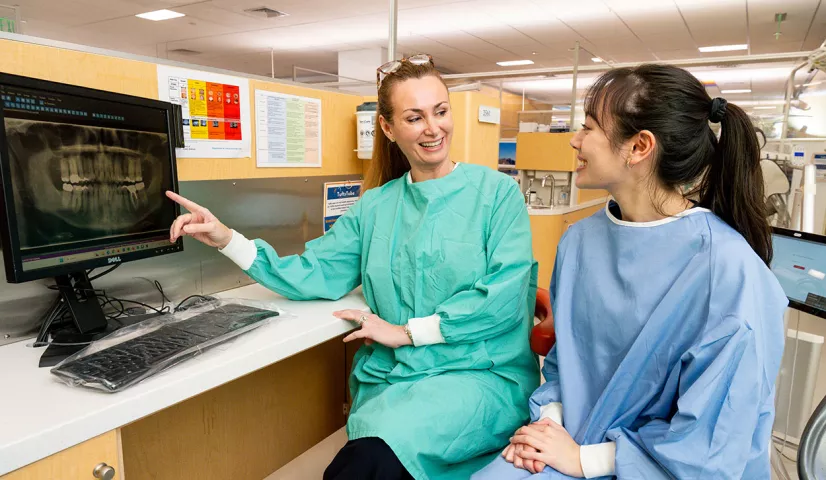
Program Goals and Objectives
All students who graduate from the DMD program must be:
- Knowledgeable in biomedical, behavioral, and oral health sciences and dental clinical care, and their interrelationship through evidence;
- Skilled communicators, health advocates, and compassionate caregivers;
- Professional, behaving ethically and being a valuable members of a team;
- Lifelong learners, improving based on practice and quality improvement principles;
- Knowledgeable members of the healthcare system, understanding its organization and economics, and able to lead when indicated.
Competencies in the following areas are applied to a diverse population of patients including children, adolescents, adults, and geriatric and individuals with special needs. The competencies are organized into the following areas:
- Diagnosis
- Treatment Planning
- Emergency Management
- Oral Health Promotion
- Prevention of Pain and Anxiety
- Malocclusion and Space Management
- Oral and Maxillofacial Surgical Therapy
- Oral and Maxillofacial Pathology and Radiology
- Endodontic Therapy
- Operative and Prosthetic Therapy
- Periodontal Therapy
- Community Involvement
- Practice Management
- Ethics and Professionalism
- Information Management and Critical Thinking
- Basic Sciences
Build the scientific foundation you need to become a skilled and confident clinician. The basic science curriculum begins in August with courses in Dental Anatomy/Craniofacial Function and Introduction to Research. From September through December, you will explore basic concepts in biochemistry and nutrition as well as clinical (gross) anatomy which provides a detailed study of the body’s structure through lectures and cadaver dissections.
In the second term, the curriculum is a systems-based approach that brings multiple disciplines together, including histology, physiology, medicine, pathology, pharmacology, immunology, and infectious diseases. Lectures are presented by basic scientists from the School of Medicine and the Tufts Graduate School of Biomedical Sciences, dentists from the School of Dental Medicine, and physicians from Tufts Medical Center who integrate information relating to normal structure and function of the body with that of various disease states and their potential impact on chairside management of patients.
Course content is presented in a variety of formats including traditional lectures, interactive (flipped) classrooms, and case presentations. Courses in the integrated curriculum include introductions to structure and function of the body’s tissues and the mechanisms of drug action (Tissue Biology). The Tissue Injury and Host Defense course combines lectures in infectious disease, pathophysiology of wound healing, immunology, and pharmacology to cover the body’s inherent responses to infection as well as the use of therapeutic agents. The remaining integrated courses explore the major organ systems, cardiovascular, respiratory, renal, gastrointestinal, and endocrine.
The behavioral sciences include the areas of professionalism, communication, and how to manage patients with of varied backgrounds, ages, and levels of anxiety.
The School structures the behavioral sciences curriculum as an integrated part of coursework throughout all four years of the dental school curriculum. The implementation of behavioral science principles is recognized as being fundamental to the successful practice of dentistry and therefore is repeated and stressed throughout the various contextual elements of the curriculum.
Introduction to the Dental Patient (IDP I) course will continue into years 2 and 3 as IDP II and IDP III and focuses on how students/practitioners should communicate with different groups of patients and staff.
In the Microbiology/Oral Health Promotion (OHP) OHP course, several lectures highlight aspects of diversity in dentistry. The lecture on interviewing and communications skills highlights the importance of acceptance and being non-judgmental as essential to helping people understand and change habits. Other classes include Health Communication and Dentistry: An Overview, Dental Public Health: Oral Health Disparities, Management of the Special Needs Dental Patient, and Preventive Management of Medically Compromised Patients.
During the second year Oral Health Promotion/Nutrition Seminar, students apply the principles of dental care to the care of children and adults with special healthcare needs. Led by a faculty member experienced in caring for patients with special needs clients who attend one of Tufts’ external dental facilities, the case-based seminar provides an interactive discussion of how to overcome barriers to effective oral health promotion care for special adults and children. Behavioral management techniques are stressed, along with guidelines for appropriate age and condition-specific preventive care.
Medicine I, II (year 1 and year 2) courses introduce students to the idea of cultural competence and the influence of culture on health and illness behaviors; communication with patients in a culturally sensitive manner is also emphasized from the beginning of the first year of the curriculum.
The didactic and preclinical portions of the clinical sciences are taught from year 1 through year 3 followed by seminars and rotations in year 4. In year 1 the students learn dental anatomy and craniofacial function, followed by operative dentistry where students begin to learn technical skills. The didactic/preclinical sciences build with courses in Operative Dentistry, Dental Anatomy, Craniofacial Function, Orthodontics, Endodontics, Periodontology, Prosthetics, Endodontics, Oral Pathology, Oral Radiology, Pediatric Dentistry, and Oral Surgery in years 2 and 3. The integration of the clinical sciences is coordinated through the Introduction to the Dental Patient Courses (IDP I and IDP II).
Basic Science/Clinical Science Spiral Seminar Series (BaSiCSsss involves students from each year of the curriculum in a patient-based case presentation/discussion. These cases are used to present patient-centered clinical information (medical and dental findings, clinical and radiographic findings, etiology, diagnosis, treatment planning). Each student is responsible for a certain aspect of each case (third year: evidence-based dentistry, second year: abnormal conditions, first year: normal conditions). Each student attends four seminars, including the one in which they present.
Students begin seeing patients in April/May of their second year. They work in group practices under the supervision of Practice Coordinators—faculty who oversee overall treatment and progress of the students. Students work with faculty from different disciplines to provide comprehensive care and rotate through various specialty clinics in the school. Students provide care to patients in extramural sites for five weeks in community health centers. They also rotate to clinics in the community to care for patients with special needs, as well as pediatric patients.
In the Introduction to Research course, students are exposed to science and research. Most students work on their research during the summer between years 1 and 2 and many students present their work at national meetings.
Students are involved in several global health initiatives in areas around the world, including Africa, the Caribbean, and South America.
To me, Tufts has been a second home, and I get pure joy in giving care to my patients based on what I’ve learned from my professors and my faculty […] the education is one of dreams.

Meet the Faculty
Browse our directory to meet the talented and accomplished faculty that lead this program.
Financing Your Education
Students enrolled in the DMD program can access a wide variety of both federal and institutional financial aid. Both merit and needs-based grants are available to those students who qualify.
Featured Students


