
The Department of Public Health and Community Service (PHCS) is responsible for training Tufts students in a wide range of topics during the four years of predoctoral studies. The main objectives of public health training at Tufts University School of Dental Medicine (TUSDM) are to:
- Enable students to recognize the influence of social determinants of health on oral health practices, disparities, and quality of life across the lifespan
- Enable Tufts students to identify best practices for oral health promotion and disease prevention at both the individual and community levels
In addition to competing public health coursework, Tufts students can work in diverse clinical settings during their externship rotations and, in select cases, to travel overseas along with Tufts faculty to provide dental care to low-resourced communities in Africa and South America.
Population Oral Health
The Population Oral Health course provides students with information regarding oral health and effective strategies for oral care at the community and population levels. This course promotes the development of an oral health workforce with the skills to work effectively with diverse people and environments in the context of health care systems. Students come away with a deep understanding of the multiple factors that may contribute to oral health disparities and inequities among diverse population groups. The course is structured to develop the ability of students to critically reflect on concepts of population oral health.
Lead Faculty: Nicole Holland
Introduction to the Dental Patient
The Introduction to the Dental Patient course spans the fall and spring semesters of the first year of dental education. It focuses on acquisition foundational knowledge, attitudes, and skills that will be applied to future patient-centered and culturally and linguistically sensitive comprehensive care of the dental patient. Through online, self-paced learning modules and in-person interactive sessions, students are introduced to communication skills for effective history-taking, patient education, and behavior change counseling. Strategies are introduced to help students provide sensitive and equitable care to patients with a wide range of common comorbid conditions, including functional challenges and disabilities, chronic pain conditions, mental health, and substance use disorders. Throughout the course, students reflect on practical ways to apply the principles of patient centered care in dental settings and work in small groups to apply acquired knowledge and skills to complex case scenarios.
Lead Faculty: Ellen Patterson
Adults Over 50/Geriatric Dentistry
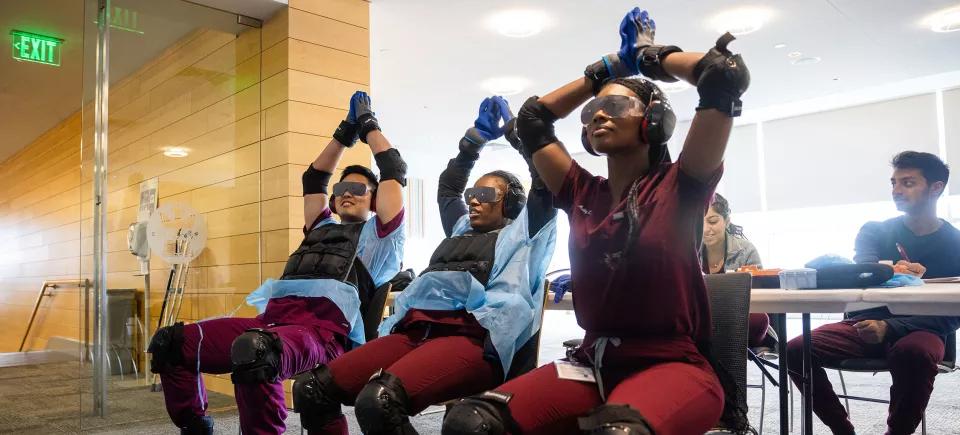
Adults Over 50/Geriatric Dentistry is a second-year course that helps prepare students for direct clinical patient care and provides them with foundational knowledge of the aging process and its relationship to oral health, general health, and wellbeing. Oral disease worsens chronic health conditions and impacts daily life, including the ability to communicate, chew, and swallow - which can result in poor nutrition, isolation, pain, and lack of sleep, among other issues. Tooth loss, decay, and gum disease are not inevitable consequences of aging, yet dental disease is one of the most prevalent and neglected chronic conditions in adults over 50. The course integrates biomedical, clinical, and behavioral science principles and highlights special considerations in diagnosing, treatment planning, and managing high-risk patients over 50.
Lead Faculty: Karin Arsenault
Epidemiology / Population Health
The Epidemiology course for predoctoral DMD students covers the specific aspects of epidemiological methods and analysis of common oral health diseases and disorders. Emphasis is placed on the assessment of oral health outcomes and their distribution in populations. Students will learn about the measurement and epidemiology of oral diseases and their impact on quality of life. The content of the course is structured to develop the ability of students to critically reflect on concepts of population oral health. Course modules include Study Design and Measures; Confounding, Bias, Random Variation, P Values and Confidence Intervals; Epidemiology of Dental Caries, Periodontal Disease, Oral Cancer, Oral Trauma and Other Oral Conditions; Global Trends; Global Goals; Back to Basics/Primary Care and Social Determinants and Risks.
Global Service Learning
The Global Service Learning program aims to place students in international or domestic missions that offer free dental services. The goal of the program is to enhance understanding of the cultural and social determinants of health, improve oral health equity and prepare an oral health workforce to be global leaders in oral health. To achieve its mission, the program provides both academic preparation and outreach experiences. The academic preparation, for faculty and students who participate in these short term cross-cultural clinical experiences, is structured to develop knowledge related to international practice of dentistry, the ability to interact across different cultures, to critically reflect on concepts of service-learning, synthesize theory and practice of service-learning and enhance the Global Service Learning experience. We foster intercultural understanding while providing oral health services to underserved populations identified by partnering agencies, institutions, and universities.
Lead Faculty: Thanos Zavras
Intercultural Competence for Oral Health Providers
The Intercultural Competence for Oral Health Providers course continuum spans over a three-year period, offered to first, second-, and third-year dental students. This workshop series, Exploring Healthcare Systems in the U.S. and Racism as a Determinant of Health, helps students develop an understanding of the complex structural, ideological and cultural foundations of race, and examine how institutional racism can be identified in systems in the U.S., including health care. Students critically examine and analyze institutionalized, structural racism and health disparities, investigate the impact of forms of bias on decision-making processes and gain an awareness of how socialization relates to formation of biases. While building effective communication skills, students explore how health disparities are linked to societal inequities and how to create a welcoming environment for patients, displaying cultural competence and cultural humility, along with recognizing tools and approaches to help dismantle institutionalized racism.
Lead Faculty: Jeanette Sabir-Holloway